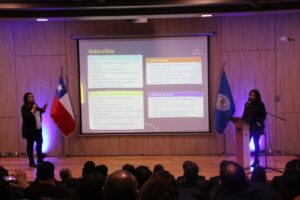
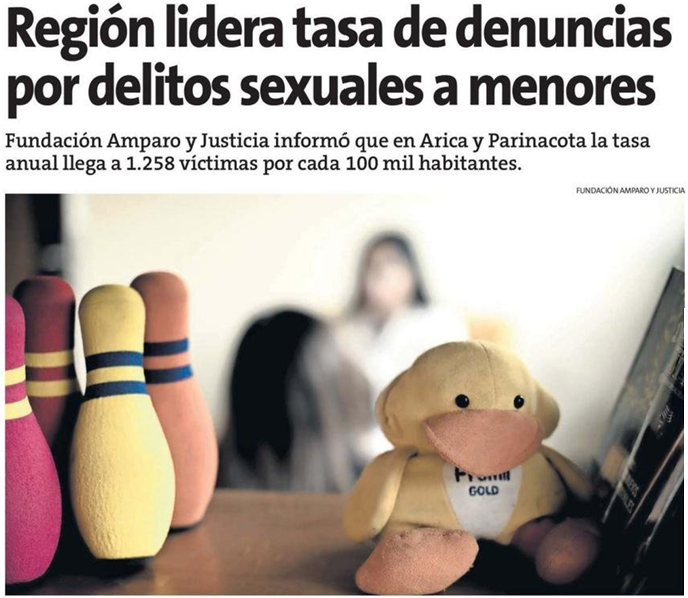
Fundación Amparo y Justicia reported that in Arica and Parinacota the annual rate reaches 1,258 victims per 100,000 inhabitants.
The Arica and Parinacota Region remains the area with the highest rate of reports of sexual offenses against children and adolescents in Chile.
According to an analysis by Fundación Amparo y Justicia, the region records an annual rate of 1,258 victims per 100,000 minors, almost double the national average (710). In addition, 822 cases were recorded in 2024, representing 2.58% of the national total. In this way, the rate makes it possible to gauge the magnitude of the problem in relation to the regional population, while the annual figure shows how many cases actually occurred during 2024.
The study also warns of a troubling response from the criminal justice system. While at the national level the dismissal of cases involving sexual offenses against children and adolescents reached 74.3% in 2024, in Arica and Parinacota the rate of formal charges fell sharply from 15.53% in 2018 to just 4.77% in 2024.
“When a case is dismissed, it does not mean that the crime did not occur. What we are seeing is a weakening of the institutional capacity to respond. Victims are being left without justice, and that is unacceptable,” said María José Bowen, Legal Deputy Director of Fundación Amparo y Justicia.
Critical factor
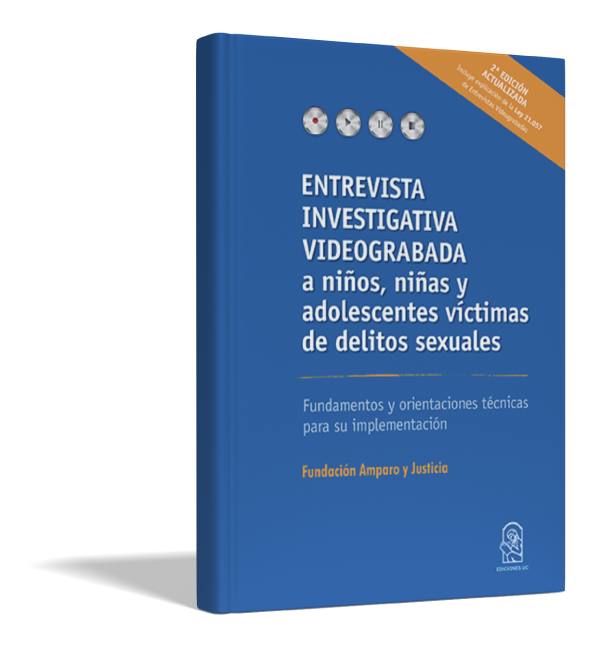
The study identifies the insufficient use of the videorecorded investigative interview (VIVI) as a critical factor—an essential tool for obtaining high-quality testimony without re-victimizing children.
At the national level, only 40.1% of victims had access to a VIVI in 2024, and in 57.8% of cases the procedure was carried out more than one month after the report was filed, far from the international recommendation of a maximum of 15 days.
Bowen warned that “without a timely investigative interview, many cases lose viability. When used promptly, it radically changes the chances of a case moving forward.”
Regarding the regional figures, Cristián Pinto, an academic at the University of Tarapacá, noted that “one of the factors that may explain this trend is the greater sensitivity that now exists within the community and the protection ecosystem to make these situations visible. When there is greater awareness, people report more.”
Pinto added that territorial factors also play a role: “We are in a tri-border area, a space where human mobility is more intense. It is not that the city generates crime, but rather that its location makes it a strategic point of transit and concealment for certain phenomena linked to sexual violence.”
The report warns that unless operational gaps are addressed and local capacities strengthened, the region will continue to face high levels of reported cases.