Skip to content
  • About Us
    Our
    purpose
    Milestones
    Us
  • Our Work
    Family
    interventions
    Homicides
    against children
    Sexual crimes
    against children
  • Digital Library

    Digital Library

    Learn more
    Topics
    Sex crimes against children and adolescent
    Child and adolescent homicides
    Comprehensive intervention in sexual homicide cases
    Video-recorded investigative interview
    International Regulations and Guidelines
    National Regulations and Guidelines
    Annual Reports
  • News

    News

    Learn more
    Categories
    Intersectoral Group
    Talks and seminars
    Team
    Sex crimes against children and teens
    Homicides against children
    Talks and seminars
    Studies and Publications
    Videorecorded Interviewing Law
    Cases
    Professional Certificate Program
  • Es
Search in...
Main Menu
  • Home
  • About Us
  • Our Work
    • Family interventions
    • Sexual Offenses Against Children
    • Homicides Against Children
  • News
  • CEFAJ
  • Digital Library
  • Resource Center
  • Project: Intersectoral Group for the Prevention and Investigation of Homicides of Children
  • Campaign:Do you know how to act if you learn about a sexual crime?
  • Es
Facebook-f X-twitter Youtube Instagram Linkedin
  • Intersectoral Group, Child and adolescent homicides

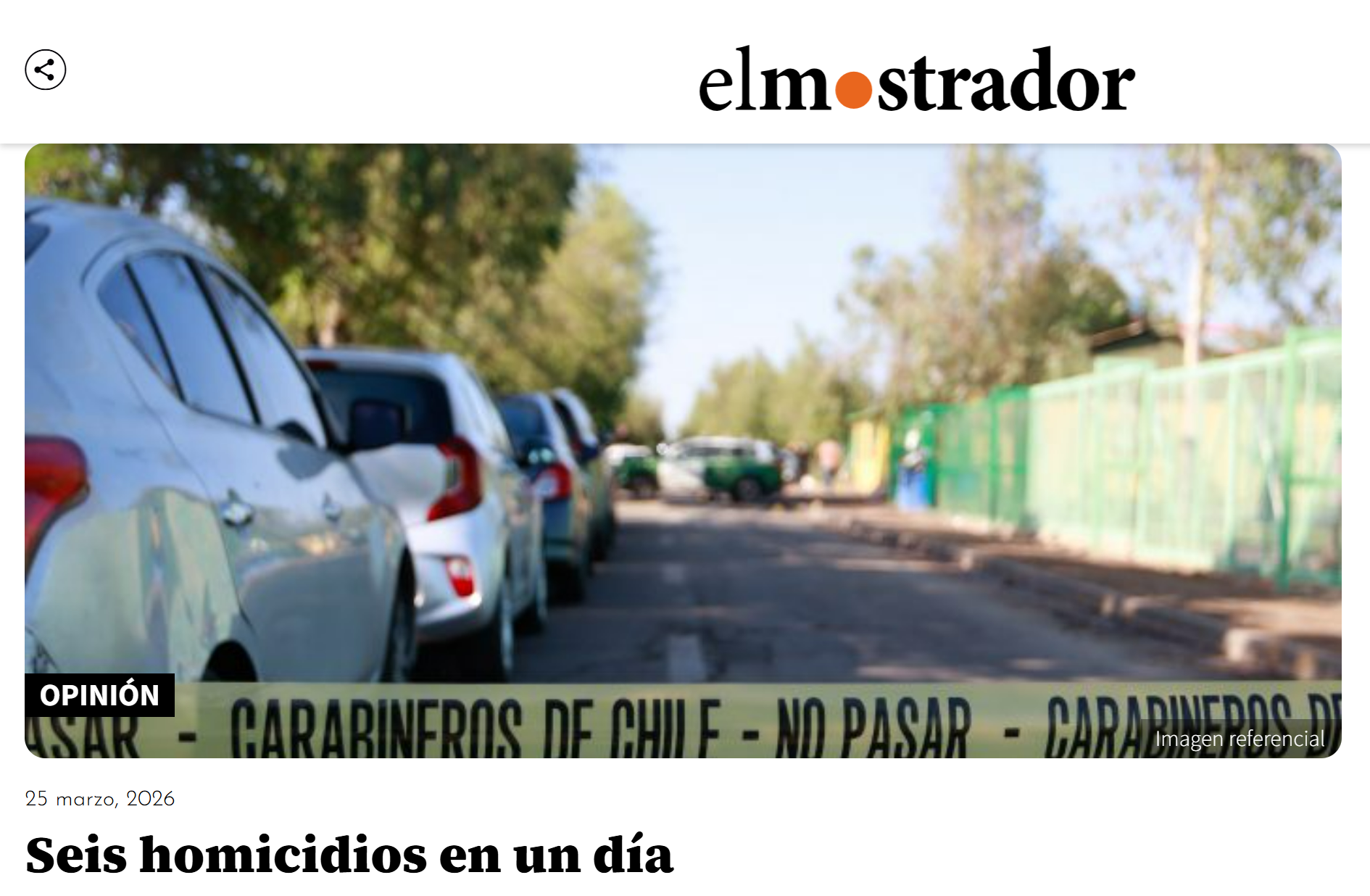
El Mostrador | Six Homicides in One Day

  • 30 de March de 2026

Por Pía Greene, directora ejecutiva de Fundación Amparo y Justicia

In less than 24 hours, six people were murdered in the Metropolitan Region. Among them, a 17-year-old teenager on his way home who was shot in broad daylight. The incident is shocking — but sadly, no longer surprising.

These cases, increasingly less isolated, demand urgent attention. Organized crime has become a driving force behind homicides of children and adolescents. In 2025, 40.4% of these deaths were linked to that context — a higher proportion than observed in homicides overall. Firearms were used in more than half of the cases, and six out of ten occurred on public roads.

Four years ago in Chile, we barely talked about organized crime. Two years ago, we were just beginning to acknowledge it. Today, in March alone, a press monitoring effort has identified seven murders of minors, at least half of them potentially linked to this dynamic. The latest Statistical Bulletin from the Public Prosecutor’s Office shows that completed, attempted, and frustrated homicides against children and adolescents rose from 351 in 2024 to 387 in 2025 — a 10% increase, equivalent to one case every 22 hours.

These homicides do not follow a single logic. Among younger children, many deaths occur in contexts of domestic violence. Among adolescents, however, organized crime takes hold with greater force. But we cannot forget that a 14-year-old does not have the capacity to make fully informed decisions — which is why they so often end up as victims of these organizations.

Criminal gangs operate like businesses and constantly need new generations to sustain their operations. In that context, a child inside organized crime is a child potentially headed toward death.

What makes the picture even more troubling is that many of these minors were not unknown to the State. According to data from the Undersecretary for Children, around 90% of children who die from violent causes had been in contact with public institutions at some point in their lives — whether through the school system, social programs, or protective services. The State knew who they were. The problem is that this information is fragmented, and there is no coordination framework that allows timely identification of those at greatest risk.

This is not only a public safety problem — it is a child protection crisis. The evidence is compelling: an effective response requires case-by-case specialized investigation, inter-institutional protocols, and timely information sharing.

Every homicide of a child or adolescent must be analyzed in depth: their life trajectory, their environment, and the protection networks that should have been in place. Only then will it be possible to identify patterns and design public policies that prevent — not merely react.

Today there is limited technical capacity among the teams working on these cases, which hinders not only justice, but also the understanding of an increasingly prevalent phenomenon. The Intersectoral Group for the Prevention and Investigation of Homicides of Children and Adolescents, which brings together eleven state agencies, has already developed a diagnostic assessment and is working on concrete proposals with an emphasis on inter-institutional coordination.

That is progress. But without sustained effort and without the political will to translate it into action, we will continue to see children killed without understanding what went wrong — or how to prevent it.
News Categories
  • Sexual offenses against children (14)
  • Team (3)
  • Intersectoral Group (15)
  • Talks and seminars (2)
  • Child and adolescent homicides (35)
  • Outreach (78)
  • Studies and Publications (33)
  • Videotaped Investigative Interview Law (54)
  • Cases (34)
  • Books (4)
  • Reports (6)
  • Professional Certificate Program (13)

Book

Videorecorded Interviewing Act
Learn more

Related News

  • June 8, 2026
Fundación Amparo y Justicia participates in interinstitutional event marking the 5th anniversary of the Videotaped Interview Law in Valdivia

On the occasion of the fifth anniversary of the implementation of Law 21.057 — which regulates videotaped interviews (EIV) with children and adolescents — the...

Learn more
  • May 28, 2026
Justice system operators trained in forensic examination of children and adolescents by U.S. experts

The Forensic Medical Service and Fundación Amparo y Justicia organized a virtual seminar bringing together forensic experts, prosecutors, and justice system professionals from Chile and...

Learn more
  • February 5, 2026
La Tercera | A Message for the Victim

The recent approval of the law to strengthen the Public Prosecutor’s Office marks a milestone for the criminal justice system, 25 years after its establishment...

Learn more
Books
Fundación Amparo y Justicia participates in interinstitutional event marking the 5th anniversary of the Videotaped Interview Law in Valdivia
  • June 8, 2026
Learn more
Amparo y Justicia launches book on progress and challenges in the criminal justice response to sexual crimes against children and adolescents
  • January 19, 2026
Learn more
Amparo y Justicia trained staff from the Pascual Baburizza Agricultural Institute on how to respond to sexual crimes against children and adolescents
  • December 22, 2025
Learn more
Certificate
Amparo y Justicia concludes the final edition of its certificate program on the rights of children and adolescents victims of sexual crimes
  • August 11, 2025
Learn more
International expert Noemí Pereda leads the second master class of the professional certificate course on child and teen sex crimes.
  • June 5, 2024
Learn more
Amparo y Justicia y U. Católica inauguran la versión 2024 de su diplomado sobre delitos sexuales contra NNA
  • April 2, 2024
Learn more
Reports
Fundación Amparo y Justicia participates in interinstitutional event marking the 5th anniversary of the Videotaped Interview Law in Valdivia
  • June 8, 2026
Learn more
Justice system operators trained in forensic examination of children and adolescents by U.S. experts
  • May 28, 2026
Learn more
El Mostrador | Six Homicides in One Day
  • March 30, 2026
Learn more
Find us on social media!
Facebook-f X-twitter Youtube Instagram Linkedin
  • Es
  • Home
  • News
  • About Us
  • Contact
  • Our work
  • Family interventions
  • Homicides against children
  • Sexual Offenses Against Children
  • Digital Library
  • Crime Prevention - Act 20,393
  • CEFAJ
  • Resource Center
Learn more about the Luksic Family Foundations

Para ser usuario de nuestra plataforma deberás enviar una solicitud de ingreso con los datos desplegados a continuación, dicha solicitud será procesada por nuestro equipo quien le enviará la información a su correo.